Spectroscopy
Reading spectra to identify and measure absorption features — the main way I get composition and temperature information from the stars.
What's left when a planetary system dies? I study the debris that falls onto white dwarfs to find out.
I work on polluted white dwarfs — stars that have accreted rocky planetary material, leaving chemical traces in their atmospheres and sometimes maintaining dusty or gaseous disks in orbit.
My tools are spectroscopy, radiative transfer modeling, and photometric time series. A big part of the work is building and running model grids large enough to actually constrain what I'm seeing.
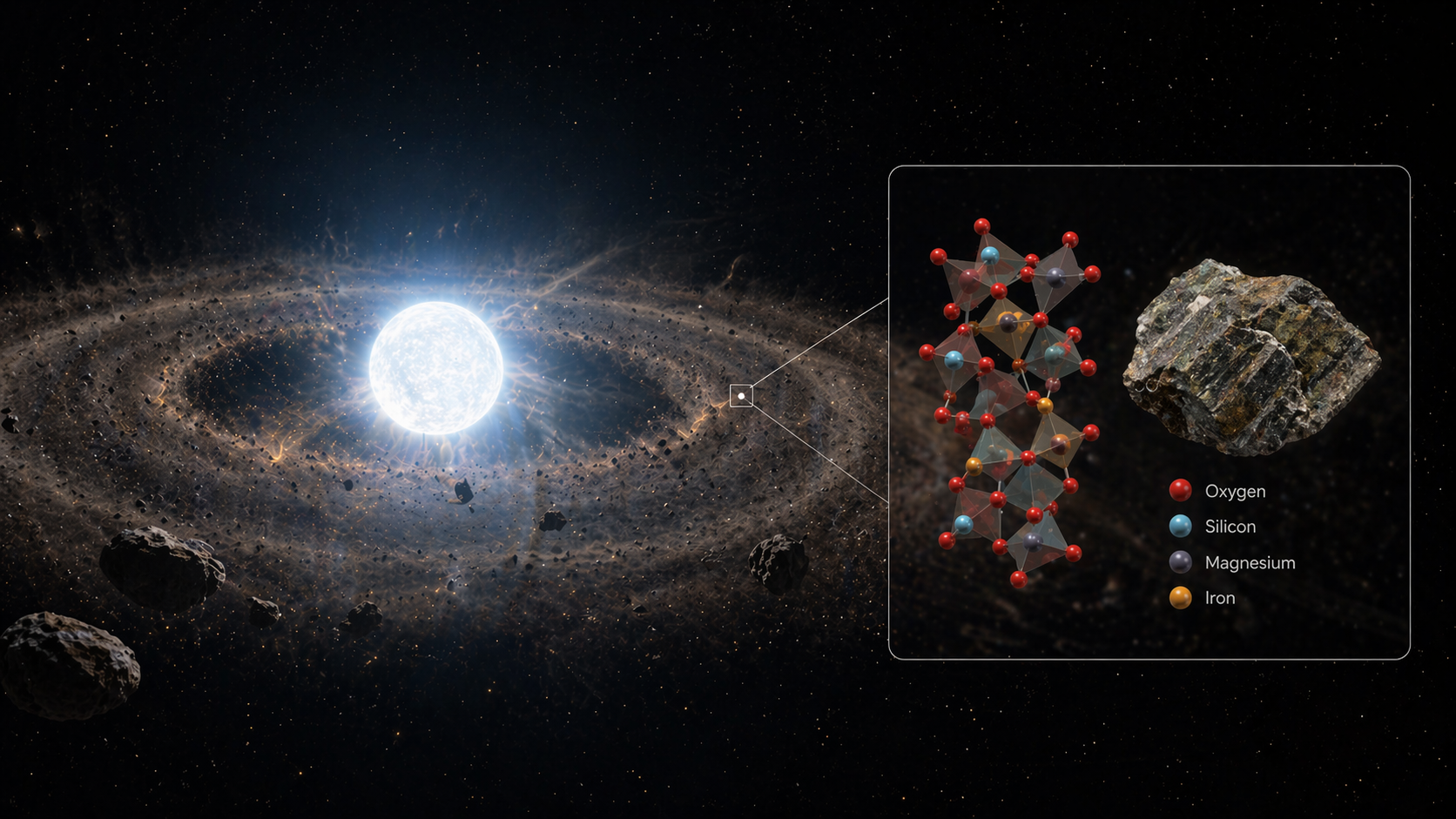
A white dwarf's atmosphere is chemically pure by default — when metals show up, they got there somehow. I study those stars to figure out what fell in and what it tells us about the parent body.
I study planetary systems after stellar death. Polluted white dwarfs act like cosmic mass spectrometers — their atmospheres record the chemistry of whatever fell in, and the surrounding disks preserve information about how it got there.
Some of these stars also have detectable disks — dust and sometimes gas orbiting close in. Modeling that material gives additional constraints on composition and the disruption history.
The research has also shaped how I write code: you learn to be patient with slow jobs, careful about what you're actually measuring, and thoughtful about what you'll want to look up later.
The data are never complete and the models involve a lot of assumptions. The interesting part is figuring out what you can actually trust.
How I actually do the work:
Reading spectra to identify and measure absorption features — the main way I get composition and temperature information from the stars.
Building models of the dust and gas around white dwarfs and comparing them to observed infrared and optical emission.
Running large grids of models to map out which parameters are well-constrained by the data and which aren't.
Python pipelines, databases, and visualization tools that make long-running analyses easier to track and reproduce.
What research actually trains you to do:
A curated list of publications, talks, and research products. See CV for a full list.